
We started our tour in Roscoff, which is in the north of Bretagne. It is a small little town surrounded by little rock islands. It biggest industries are tourism and the government centre for marine biology. Every day we were there, we saw biologists heading off in small row boats or climbing all over the rocks at low tide with their sample buckets.


The bell tower in Roscoff is unique. You can see from the picture that there are holes in the tower. These are aligned with the prevailing winds and allows the wind to pass through the tower, carrying the sound further and also preventing excessive wear and tear on the tower itself. The bell tower in Roscoff was the first to employ this type of architecture, but the idea was so useful it was copied by hundreds of other churches across windy Bretagne.


The level changes in the tides were drastic and it was amusing to walk by the harbour when the boats were lying lifeless on the sand and then come back to see the same boats happily bobbing in the waves. The changes are so extreme and the harbour has so many rocky outcrops that at low tide it is necessary to walk out onto a long bridge to gain access to the deep water ferry terminal. You can see the beginning of the bridge below on the right as it extends from the harbour.

We took the passenger ferry out to Ile-de-Batz for a day of cycling and exploration. Since the island is connected to the mainland by only a passenger ferry there are very few cars on the road. We rented bicycles at the ferry terminal and followed the road through the one village on the island to the eastern tip, and then took paths following the northern shoreline around to the opposite end of the island. The island is a mixture of undeveloped land, random houses and farms. Twice we unexpectedly turned a corner and there was a horse hobbled and munching away. It was slightly overcast but warm, and with no cars and few people it was freeing to cycle with no cares or worries.

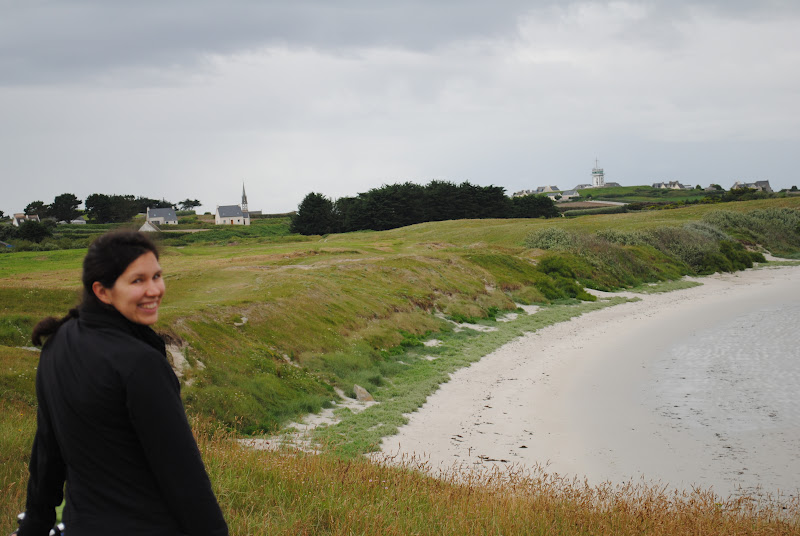


After a lovely picnic lunch on this gigantic rock, we continued on our bicycle tour. Unfortunately just as we got to the most isolated section of the island it began to rain. The intensity of it was surprising, as all the other rains we had experience hitherto had been light manageable drizzles. The umbrellas we had were pretty much useless and I used mine more to protect my camera more than myself after. The rain soaked us all the way through. I could not only feel it squishing in my sneakers but running down my back as well. We finally made it to a creperie to take shelter in and Keith warmed up with another creme de carmel crepe, while I settled for a tea.
 |
| The village on Ile-de-Batz |

After two days in Roscoff, we settled ourselves down at a bed and breakfast that was a renovated Chateau. We staid in the newer part of the house but it was really quite marvelous. The owner told us that now that he is finished restoring the Chateau his next project is to buy the mill that is just down the hill from the Chateau and restore that. We took a look at this mill and all the remains is the foundation. It seems like the retirement project to end all retirement projects.
We used the Chateau as a jumping off point to explore the area around Perros-Guirec and Morlaix. Since we had a car and the time we mostly took the minor highways, especially if they were highlighted green which means scenic route. This led us to breathtaking villages like Saint Michel where we had dinner, walked on the endless sandy beach and explored the graveyard the is situated right next to the water.

For our day in Perros-Guirec proper we were blessed with sunshine. It allowed us to walk the town, beaches and cliffs of this maritime oasis.


In addition to the lovely sandy beaches, the area around Perros-Guirec is known for its strange rock formations. Just to the north of the town the sandy beaches stop and the rock one start. The rocks are huge and placed in such precipitous ways that you think they may fall at any time. We scrambled around the rocks, down paths to lookouts and Keith actually got sunbrunt even though the temperature didn't rise above 22C.


This house was on an island surrounded by rocks, but at low tide you could walk out to it.

We also saw a coastguard ship launch. At the bottom of the picture you can see the rails that are used to guide the boat from its boathouse out to deeper water. The journey was approximately 150m when we watched it, but the beauty of this system is that is can be used a high or low tide.

The next stage of our trip took us to the south of Bretagne. On the way we stopped at La Roche Tremblante, which is a 137 tonne rock is perched in such a way that by putting your back into it and pushing you can make the rock move. Yes our vacation was seemed to be full of rocks and our destination of Carnac only confirmed that.
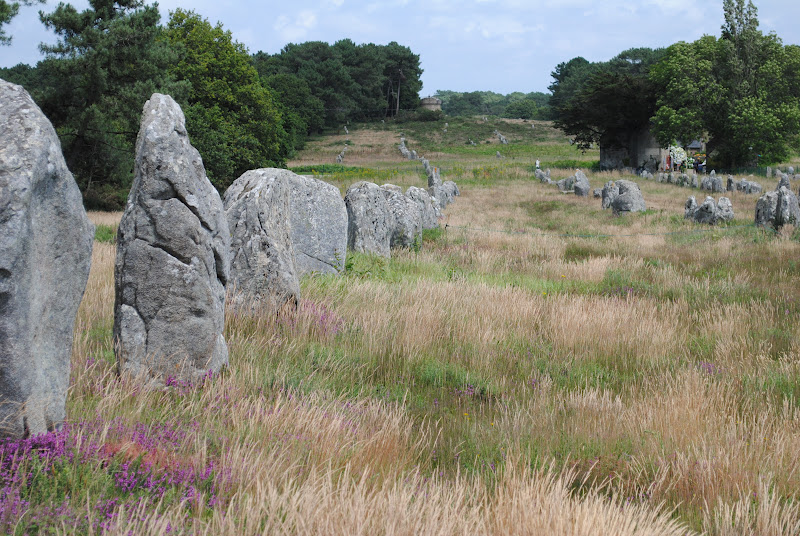
Carnac is home to three fields of megaliths. These stones were erected in long lines from stones decreasing in size sometime during the Neolithic age. We have decided that by far this is the oldest human site we have ever visited. The rocks were from the area, but no one knows why they are here and what purpose they served. The sites are closed off during the summer, but we were able to take a guided tour of one of the sites.
 |
| Here is Keith with one of the larger Megaliths. |

Also found in the Carnac area are dolmen or barrows. The one above is open to view but most of the ones we saw were covered with rocks and earth to simply make mounds.These date from the same time as the megaliths and were clearly used for burials. Some we visited were small could be missed if you didn't know it was there, and others were huge and took several minutes to climb to the top. It is difficult to imagine Neolithic people putting so much effort into creating first the stone structure with large stones as wall and a roof, and then taking even more time cover the entire thing.


After thoroughly wearing ourselves out going through museums and tramping along roadsides next to the megaliths, we spent the evening in Trinite sur Mer. We went for a wonderful walk along the shore line, looked at some of the huge racing sail boats in the harbour and had a lovely dinner. The seafood throughout the trip was fantastic and especially the muscles which I tried to order every chance I got.

Many of our trips over the past year and a half have included visits to chateaus and fortresses from the Middle Ages. This trip was no exception. The Chateau de Suscinio was the summer home of the Dukes of Bretagne and did a wonderful job of showcasing the history of this region which fought to stay independent for centuries and still holds on to its culture and language in a way that was visible in big cities and little villages alike. It is situated on a peninsula between the sea and what were at one time excellent forests for hunting. With a formidable moat and the sea at its back the strategic strength of the Chateau were evident as well. Below is an example of the tiles that were found when an old church was rediscovered next to the cheateau. The most interesting things about the tiles are their different motifs. Each one represent a royal animal. This one was is a lion.


Saint Anne d'Auray above is the largest pilgrimage site in Bretagne. The church is lovely but we went to see the exhibit on ancient books. Included in these were papal bulls and ancient bibles, but most interesting were the poster boards that Jesuits used to use to teach people about living a good life. Since most of the populace could not read these boards highlighted the seven deadly sins using animals to identify them and showed how men would change should they follow the seven virtues. The detail was exquisite and methodology radical for the times.

The rest of the pictures in this blog are from Vannes, which is a city we almost skipped over but ended up really enjoying. The wooden houses are similar to many we saw in older ports all over Brittany, but here they were everywhere. The walled part of the old city contains little alleys and square full of colour just because the houses are painted so brightly. We were really impressed with the Cathedral as well that included many interesting paintings that linked the church with the local populace and demonstrated how it used to be surrounded by these wooden houses on every side. We wondered the streets, examined the gardens and walked the ramparts with the guide of a brochure from the tourist office and had a lovely lunch in another hidden little square. The town really had a different feel from so many of walled cities we have visited.


 |
| From outside the walls. |

This building was constructed right on the canal so that washer women could go down and do their washing in a covered area even in the rain. Yes that is how much it rains in Bretagne, and although it rained a bit every day I must say that we also had sunshine every day of our trip. It is still possible to go down and sit right beside the canal and imagine you are washing clothes in the current while being covered by this nice little roof.


Our only regret for the whole trip was that we did not have more time. One week was not enough to discover all of the little villages that we passed by or do all the walks that were available to us. The friendliness and calm of Bretagne provided for a tranquil holiday and hopefully we will be back.


